I’ll be writing less in this space for a few months while I’m on sabbatical and prioritizing work on my research project (a comprehensive mapping of the field of second language writing)… Watch the twitter feed for strategies and relevant articles; I’ll continue to post under @writing_faculty when I come across helpful resources or articles.
The Merits of Rubrics
This time of year, I see lots of facebook posts about piles and piles of grading. As grade submission deadlines near, some faculty find themselves questioning why they assigned an end-of-semester paper that they now have to grade. Rather than question the assignment (although there’s merit to reflecting on all aspects of our course design!), perhaps it’s time to question the grading methods.
I am a big fan of rubrics for streamlining grading, giving students effective (and consistent) feedback, and retaining a focus on the assignment objectives. To achieve these outcomes, though, you need to create the rubric as you are designing the assignment – and with an eye towards what you want students to demonstrate about their learning.
So here are a few ideas and tips to keep in mind as you reflect on this semester’s assignments and consider what you’ll do differently next time.
What the Assessment Gurus Say:
- “Responding to writing does not begin when you start to read student essays; it starts much earlier, at the point when the assignment is made.”
(Edward M. White, Assigning, Responding, Evaluating, p. 126)
- “As teachers, we know that most students find it difficult to imagine a reader’s response in advance, and to use such responses as a guide in composing. Thus, we comment on student writing to dramatize the presence of a reader, to help our students to become that questioning reader themselves, because, ultimately, we believe that becoming such a reader will help them to evaluate what they have written and develop control over their writing.”
(Nancy Sommers, “Responding to Student Writing,” p. 148)
- Nancy Sommers cautions teachers to keep the goal of the assignment in mind when responding to student writing. She notes, “teachers’ comments can take students’ attention away from their own purposes in writing a particular text and focus that attention on the teachers’ purposes in commenting” (“Responding” 149). Sommers suggests striving for continual reinforcement between comments on students’ writing and classroom instruction and activities.
- Multiple studies reaffirm the importance of addressing surface-level errors within the context of students’ authentic writing, but research also cautions that students are more likely to apply comments about lower order concerns to their future writing if teachers engage in “minimal marking.” In other words, identifying a few (two or three) categories of errors (i.e., articles, commas after introductory clauses, comma splices, etc.) in each project and prioritizing those that interfere with meaning will have more impact on future writing than identifying all errors in the project.
Value of Rubrics
- Rubrics challenge us to articulate our expectations well before we begin grading – ideally as early as when we are designing the assignment.
- In addition to being used for faculty feedback, rubrics can be used during the writing process for students’ self-assessment of their writing to help them anticipate how readers might respond and to become critical readers of their own work.
- Rubrics help faculty readers keep the goal of the assignment in mind as they are assessing student work. Well-designed rubrics also can reinforce and work symbiotically with faculty members’ other classroom instruction.
- Rubrics also help faculty prioritize items for response. If the primary intent of an assignment is to assess students’ ability to apply disciplinary content to a new problem, using a rubric can help faculty focus response on criteria related to that application, rather than getting bogged down in editing students’ papers (which might not help students’ avoid those same sentence-level errors in the future, anyway).
Tips for Constructing Rubrics
- Create a rubric that fits your context and that is tailored to the specific assignment. (One-size-fits-some rubrics can leave us all frustrated!)
- Focus on and prioritize student learning outcomes associated with the goals for the assignment.
- Format your rubric in a way that will help you use it consistently. If you want wiggle room to recognize exceptional performance on a characteristic of the assignment, build it into your rubric, so that you are more likely to use the rubric (and less likely to discard it because it doesn’t fit your grading practices).
- Select a format that matches your goals for providing feedback.
- After you grade a set of projects, make some quick reflections on how well the rubric worked so that you can revise it for future use.
- Involve students in the development of rubrics. You can:
- Ask them to identify grading criteria based on the assignment description. What do they think you are prioritizing as goals for the assignment?
- Ask them to write descriptions for levels of performance on grading criteria. Based on class discussions and readings, what would constitute excellent work on criteria A? Average work? Work that needs improvement?
- Use rubrics to guide peer-review and students’ self-assessment. If students have questions about evaluation criteria, or if you notice that they are misinterpreting an item, you can redirect them before they submit a version for you to grade (and hopefully simplify your grading, as a result).
Rubrics are not one-size-fit-all, so they do take some time to develop and adjust to fit the learning outcomes you hope to achieve with your assignment. As examples, here are two I used this semester for two different classes – a first-year writing class and a professional writing class. Click on the thumb-nail to see a full-size snapshot.
As I wrap up my own end-of-semester grading, I’m thankful I spent time when I was writing the assignments to also compose corresponding rubrics. What are your strategies for constructing rubrics that facilitate assessment of student learning and effectively communicate information to student writers?
References
Sommers, N. (1982). Responding to student writing. College Composition and Communication, 33, 148-156.
Walvoord, B., & Anderson, V. J. (1998). Effective grading: A tool for learning and assessment. San Francisco: Jossey-Bass.
White, E. M. (1999). Assigning, responding, evaluating: A writing teacher’s guide (3rd ed.). Boston: Bedford/St. Martin’s. [or subsequent editions]
Preparing for a Sabbatical
I’m fortunate to be looking forward to a spring sabbatical. After 5.5 years as a writing program administer for a first-year writing program and even more years coordinating an undergraduate professional writing and rhetoric concentration, I’m ready to recharge, to re-invigorate my research projects, and to establish some healthier habits.
I recently searched for published strategies and asked friends and family who have taken sabbaticals for tips on making the most of the brief time. A Google search reveals a growing number of calls for employees in the corporate world to consider sabbaticals but surprisingly few posts on strategies for academic sabbaticals. A library database search returns some useful hits, but far fewer on the act of taking a sabbatical than on rationales for funding them.
Two sources offer motivation: Max Page, for instance, calls for readers to retool – not to do more work, but to try new things, “explore new areas, pursue projects that might fail, expand your mind with art or music or great literature, and generally upset your routine.” Eugenia Gerdes connects this rejuvenation to the goal of academy, noting that sabbaticals offer faculty “time to think” in ways that facilitate faculty members’ roles in helping students develop a life of the mind.
My fellow academics likewise reiterated the need to recharge not only my research but also myself, encouraging me to take time for exercise – and even fun and travel. Many suggested practicing a firm “no” to campus commitments. Lynn Huber blogged about her sabbatical experience, and I highly recommend reading her posts. Lynn reminds readers that change can be hard, and I anticipate that the change in routine (i.e., the lack of classes and most meetings) will be hard for me to adjust to. She also reflects on her own preference to work on multiple projects so that she can move between them when she’s tired or frustrated with one. I share this trait and have earmarked some smaller projects to pursue alongside my primary project.
Friends responses about where they worked during their sabbaticals were, not surprisingly, as varied as their writing processes. Some worked on campus, while others advocated avoiding campus as much as possible. I initially thought I would work on campus most days, but I’ve started prepping a work space at home so that I have a change of scenery when I need it.
So what are my goals for my sabbatical? My primary goal is to complete a book project on the field of second language writing, a task that also necessitates updating my database of the field’s publications and conducting interviews to understand why and how the field has developed/is developing around the globe.
Yet I also hope to establish some new habits and re-establish some old ones, including:
- writing every day – something that has too often given way to writing for my administrative positions (but not always for scholarship projects),
- re-establishing reading habits – both for academic reading and personal reading,
- taking my dog for daily walks,
- exercising every day – beyond the dog walks and despite my asthma, and
- finding additional ways to manage stress and to seek work-life balance.
Fall semester grades are due December 15th, so I’ll use this month to start forming some of these daily habits in anticipation of jumping into my sabbatical research after the holidays. I’ll keep you posted on my progress.
Works Cited:
Gerdes, E.P. (1998). Remembering the contemplative life. Liberal Education, 84.2, 58-62.
Page, M. (2010). Who took the Sabbath out of sabbatical? Academe, 96.5, 32-35.
Goal Setting
A significant part of successful, sustained writing is goal setting. Whether I’m working with faculty at a week-long writing retreat or collaborating on a co-authored manuscript, regularly setting goals keeps the writer(s) on track. Yet, not any old goal will do. There’s an art to setting feasible, productive goals, and it hinges on an awareness of your own writing process and a recognition that you can’t go from zero to finished in one fell swoop.
At week-long writing retreats, I ask participants to set a goal for the week. At the end of four dedicated days for writing and eliciting feedback from faculty colleagues, what do they hope to have accomplished? Faculty goals often include: a completed article/chapter draft, a significant start on a manuscript and a timeline for completing it during the coming summer or semester, a coherent literature review, or revising a full draft for a new target audience.
Faculty make progress towards, and typically complete, these goals because they also publically set daily goals. The daily goals break down the larger task into manageable pieces, and sharing them publically with others at the writing retreat makes faculty accountable for completing them.
Setting successful daily goals takes some practice, though, and requires writers to know a bit about their own writing processes. Writing 1000 words might be a good one-day goal for a binge writer who can get everything down on paper or the screen without stopping to edit continuously, but a writer likely won’t meet the goal if her writing process involves completing and revising a section at a time. Similarly, anyone who has a tendency to keep reading the literature and who struggles to stop reading to write, needs daily goals that both work with that habit and help the writer move past it. Therefore a one-day goal might be writing summaries of and pulling key ideas from a specific number of viable sources. The next daily goal, though, should push the writer to begin synthesizing what she’s read, without looking for more sources; looking for more sources to read can become a reward for identifying actual gaps in the literature review after the writer has completed an initial draft. These daily goals keep the writer on track to meet the larger goal of composing a coherent literature review or even completing an article draft.
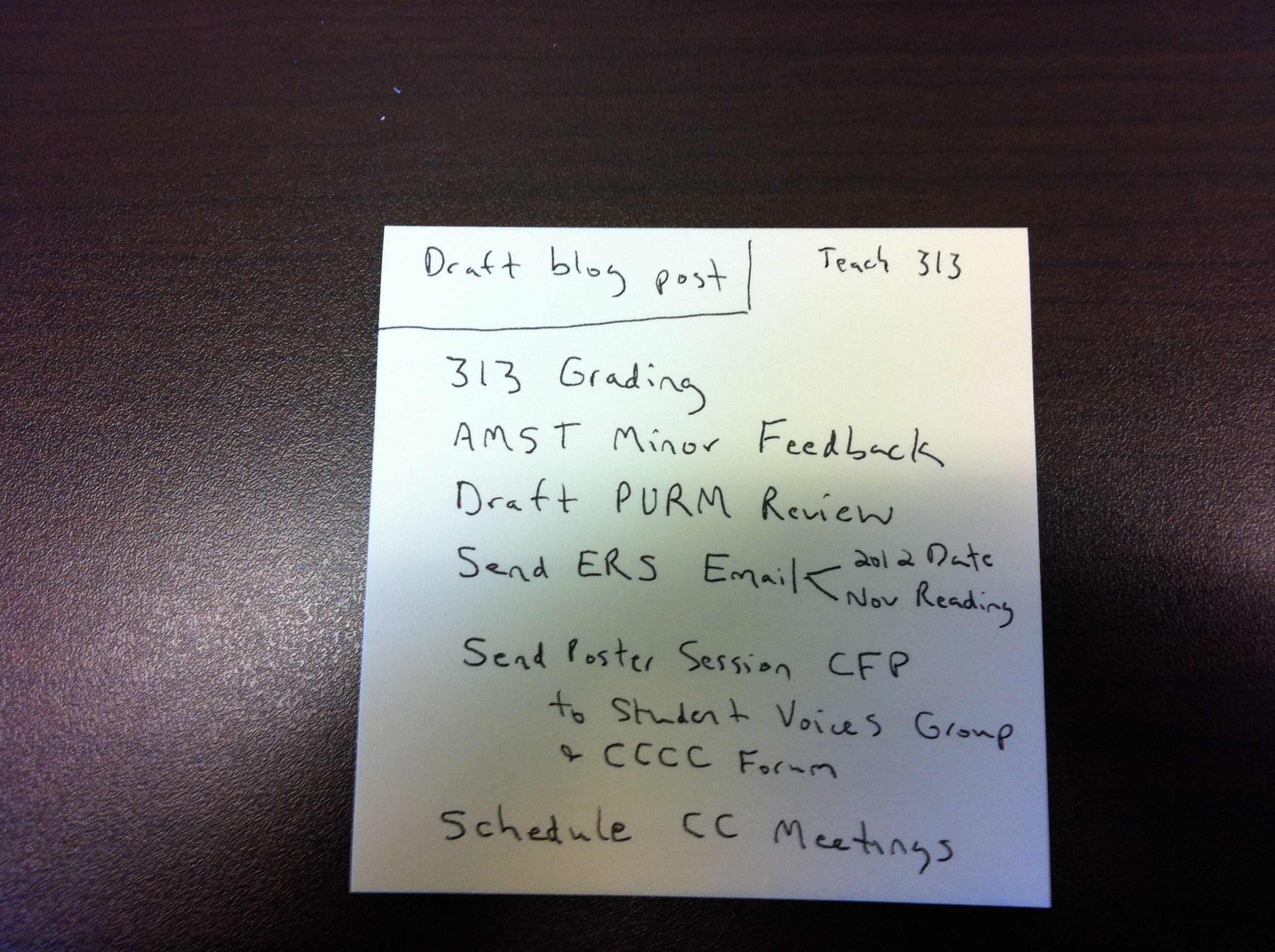
These same goal setting strategies transfer to writing projects throughout the year. For my own writing, I set weekly writing goals and write them on a small (1 3/8 inch by 1 7/8 inch) sticky-note. I post the sticky-note on a filing cabinet next to my computer, where it remains visible throughout the week. Then I create daily to-do lists on larger (3 inch by 3 inch) sticky-notes, incorporating smaller writing goals into those daily to-do lists. (See “If It Won’t Fit on a Post-It, It Won’t Fit in Your Day” for a strategy for prioritizing your to-do list.) My daily writing goal is always the top item on my to-do list so that it doesn’t get lost; even if I can’t start working my way through my to-do list until after I’ve taught three classes, the placement of my writing goal at the top of the sticky note reminds me to make time for my writing.
Finally, these daily writing goals take some pressure off. That might initially sound counter-intuitive. Yet, if I write every day, working towards small daily goals, I make steady progress towards the weekly goal and longer-term goals. Therefore even if one day’s work isn’t as strong as I would like, I can look at four other days’ worth of work for the week and know that the quality balances out – and I’m making progress. I’m not forcing myself to be super productive and on task to meet my entire writing goal in one- or two-day binges. If I write for one hour each day for twenty work days, even with a less productive day here or there, I end the month with more productive writing hours than I could squeeze into a binge writing session.
So since it’s the start of a new week, here’s a peak at my weekly writing goals and my Monday to-do list:

Not So Native
On Inside Higher Ed, Steve Kolowich posted a summary of a Student Monitor survey on students’ campus computing habits. According to a fall survey, most students continue to use campus computers – at least occasionally – even though 95% own their own computers. Students also continue to use Microsoft Word more often than Google Docs or OpenOffice.
What does this news mean for teaching writing? Colleagues at Elon University and I studied the digital literacies of first-year students, and our findings suggest that entering students are overly confident about their ability to use the full range of tools in Microsoft Word. Most do not enter college knowing how to use Track Changes and Comments, for instance, two tools that can be helpful for collaborative writing and peer review.
Therefore if you are integrating digital peer review or expecting students to write collaboratively, consider taking a few minutes to introduce students to relevant digital tools.
Preparing for 2012: Writing Every Day
No, I haven’t skipped a year. I’m looking ahead to a sabbatical in spring 2012 and eager to establish better writing habits. I have always been a binge writer inspired by (or truthfully, in desperate need of) deadlines. I do a lot of advance planning, but I have a nasty habit of leaving my writing, revising, and editing until the last minute, and if my sabbatical is going to be productive, I need to establish some better writing habits. Fortunately, I have a whole year to do so.
Therefore, one of my New Year’s Goals is to write every day. Kerry Ann Rockquemore repeatedly advocates writing 30-60 minutes every day, but I need to ease into daily writing. For the month of January, my goal is to write 15 minutes a day (here and elsewhere), following the Joan Bolker approach. Chances are good that I won’t stop at 15 minutes most days this month, but as I said, I’m easing in.
I’ll post updates here at least weekly, and I invite you to join me in this writing challenge – or to establish your own writing goal. Need inspiration? Check out Rockquemore’s archived columns in Inside Higher Ed and Karen Hoelscher and Carmen Werder’s column in the same publication.